World Bank USDC
The World Bank Group will test paying out development money in USDC with Circle and Citi, alongside correspondent banks, on a platform that already tracks flows across more than 350 projects in 96 countries
The World Bank Group said on Tuesday, 17 November 2026, that it will test sending development money as regulated US dollar stablecoins, working with Citi and Circle. The aim is to make disbursements faster and cheaper than through correspondent banks alone. Circle will mint and settle the funds in USDC, its dollar stablecoin, and Citi will connect the new rails to the banking system.
The test runs alongside the existing correspondent banking route rather than replacing it. Borrower countries will take part, and the first model is intermediated: banks and payment firms stand between the stablecoin and the final recipient.
Where the money goes today
The World Bank Group is owned by 189 member countries and is made up of five institutions. In the fiscal year to 30 June 2026 it committed USD 123.5 billion in loans, grants, equity investments and guarantees.
| Region | Commitments | Share of total |
|---|---|---|
| Sub-Saharan Africa | USD 35.8bn | 29% |
| Latin America and the Caribbean | USD 25.1bn | 20% |
| Europe and Central Asia | USD 24.6bn | 20% |
Figures from the World Bank Group annual report, shares calculated by Finflags, checked on 18 November 2026.
Finflags calculates that the three regions took USD 85.5 billion, or 69% of the year’s total. Sub-Saharan Africa, where cross-border payments are among the most expensive and slowest in the world, gets the largest share, and it is where faster settlement would matter most.
On a related subject, read our report “Plasma One Core”, from November 3, 2026.
How the test will work
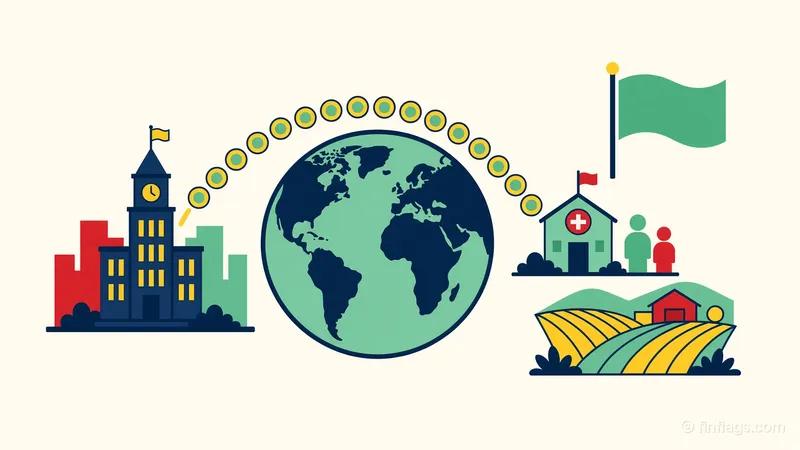
The project builds on FundsChain, a platform the World Bank already uses to track money across more than 350 projects in 96 countries. Today a disbursement passes through a chain of correspondent banks, each adding time and fees before the money reaches a ministry, a contractor or a local bank. A USDC transfer settles on a blockchain within minutes, and each step can be traced.
Ajay Banga, the World Bank Group’s president, said faster money means “a health clinic gets built on time, a farmer gets paid before the harvest season ends”. Jeremy Allaire, Circle’s chief executive, said development finance is “one of its most important applications” for an internet-based financial system.
A public-sector test for USDC
A multilateral lender using USDC for official payments gives regulated stablecoins a public-sector use beyond trading and remittances. It also tests the last step, where dollars in a digital wallet have to become local currency in a bank account at a fair rate. That is the same problem individual users face, and how much it costs at today’s services is set out in USD and USDC to EUR.
The World Bank did not give a start date or a size for the test.
Which banks and fintechs open an account on your passport is in our account filter, which covers 124 providers in five countries.
You may use the information in this article provided you include a link to Finflags and to this article.
This article covers World Bank Group, Circle and Citi. Written by Mary Jane, our lead journalist, and checked by the Finflags editors. The date above is the date of the event. Fees, limits and terms change: tell us if something here is out of date.