What is Zelle
How Zelle moves money between U.S. bank accounts, what big banks let customers send, how fast it arrives and what protects a payment.
In this article
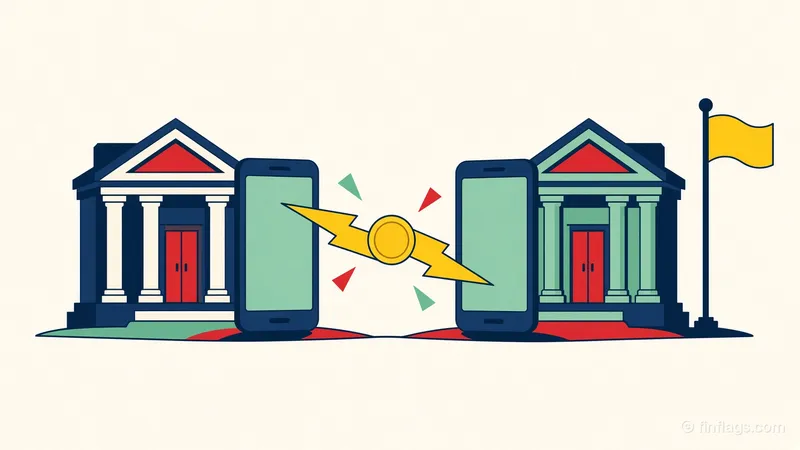
Zelle is a payment network that moves money between checking and savings accounts at banks and credit unions in the United States. The sender needs only the recipient’s U.S. mobile number or email address. Zelle works inside the customer’s own banking app, and Early Warning Services, LLC owns and operates it. Early Warning in turn belongs to seven large U.S. banks. Money reaches an enrolled recipient within minutes, and none of the big banks Finflags checked on November 20, 2026, charges a fee to send it.
The protection is tied to the account rather than to the purchase. Federal rules make a bank investigate a transfer that someone else made from a customer’s account. A payment the owner sent to an enrolled person stays with that person, so Zelle fits rent, shared bills and family payments best.
| Bank | Daily sending limit | Monthly or 30-day limit | Fee charged by the bank | Enrolled-recipient speed |
|---|---|---|---|---|
| Bank of America | $3,500 and 10 payments after 60 days enrolled; $1,000 in the first 30 days | $20,000 and 60 payments | None | Typically within minutes |
| Wells Fargo | $3,500 in a rolling 24 hours | $20,000 in a rolling 30 days | None | Typically within minutes |
| Chase | Set for each payment; shown in the app | Shown in the app | None | Usually a few minutes; select payments 1 to 2 business days |
| Capital One | Shown in the app | Shown in the app | None | Typically within minutes |
| U.S. Bank | Shown in the app | Shown in the app | None | In minutes |
| Truist | Shown in the app | Shown in the app | None | Typically in minutes |
| Citi | $2,500 for a standard tenured account; $500 while untenured | $15,000 tenured; $2,500 untenured | None | In minutes in most cases |
| PNC | Shown in the app | Shown in the app | None | Typically in minutes |
Limits for personal accounts from each bank’s Zelle help page, Zelle service terms or online banking agreement; fees from the same pages and Truist’s fee schedule effective December 7, 2026; checked November 20, 2026.
Finflags read Zelle’s help center and newsroom, two Early Warning pages, the Zelle pages and service terms of the eight banks, and Regulation E on the Consumer Financial Protection Bureau’s website. Where a bank prints no dollar figure, the table says what the bank says: the limit appears in its app or online banking. Truist printed its Zelle limits only in a 2022 guide for clients moving from SunTrust, so the table leaves that figure out.
How does Zelle work?
Zelle never holds the money. Its guide from August 17, 2026, says the network “acts as a messaging service between participating financial institutions,” so the payment moves straight from one bank account to the other. The same guide says the funds stay in FDIC-insured deposit accounts the whole time.
A customer enrolls once, inside the bank’s app or online banking, with a U.S. mobile number or an email address. Small businesses can also take payments through a Zelle tag, a handle the network has offered since 2025. Zelle lists the menus where banks usually place it, such as Send Money, Pay & Transfer and Move Money.
Both people need an eligible checking or savings account at a U.S. bank or credit union. Zelle’s help center says it does not work across borders: sender and recipient must both hold U.S. bank accounts. A customer without a smartphone can use Zelle in online banking where the bank offers it there.
Some banks add their own steps. Capital One asks for a one-time passcode before a payment, and U.S. Bank requires the mobile number to sit in the customer’s profile for at least three calendar days. Zelle does not ask for the bank details covered in Finflags’ guide on what is a routing number.
Who owns Zelle?
Early Warning Services owns the Zelle brand and runs the network. In a press release dated June 11, 2026, the company said it “is owned by seven of the nation’s leading financial institutions including Bank of America, Capital One, JPMorgan Chase, PNC Bank, Truist, U.S. Bank, and Wells Fargo.” Its consumer page names the same seven banks and describes Early Warning as a nationwide specialty consumer reporting agency.
Banks set up Early Warning more than 35 years ago to share data on deposit risk and fraud, according to its own history page. The company became wholly bank-owned between 2006 and 2012 and later launched the Zelle network. Zelle dates its own launch to 2017.
Zelle reported on February 11, 2026, that consumers and small businesses sent more than $1.2 trillion through it in 2025, up 20% from 2024. The network carried 4.2 billion payments that year, and 100 million bank and credit union accounts used it in December alone. In August 2026 the network counted more than 160 million enrolled accounts.
Which banks support Zelle?
Zelle says it is available in more than 2,400 bank and credit union apps. It added 337 institutions that went live or signed up during 2025, and 97% of them were community banks and credit unions with less than $10 billion in assets. “Zelle already reaches 80% of U.S. bank and credit union accounts,” Denise Leonhard, general manager of Zelle, said on January 27, 2026.
Every participating institution must offer Zelle in its app, Zelle’s help page from September 9, 2026, says, and some also offer it in online banking. The seven owners all carry it, and the reviews of Chase, Bank of America, Wells Fargo, U.S. Bank, Truist and Capital One cover their accounts in full. Citibank joins them as a member bank outside the owner group.
A customer whose bank is not on the network has one route: an account at a bank or credit union that offers Zelle. Zelle keeps the full list on its Get Started page. Some accounts at member banks also stay outside Zelle, such as Bank of America Advantage SafeBalance Banking for Family Banking.
How much can you send with Zelle?
Each bank sets its own Zelle limits. Zelle itself only says that participating institutions “may have transaction limits.” The banks that print figures tie them to how long the customer has used Zelle. Bank of America raises the daily cap in steps over the first two months, and Citi applies lower limits during an untenured period.
Citi’s terms say that period also returns after a change to the profile, such as a new mobile number, email address, Zelle tag or linked account. Bank of America adds lower daily caps for recipients: $500 for a person not yet enrolled with Zelle and $2,000 for a recipient added in the last five days.
Chase sets the limit for each transfer at the moment the customer sets it up, based on factors that include the recipient, and shows the remaining amount for the day in the app. Its terms say Chase does not limit how much a customer can receive each day. Capital One sets no limit on payment requests, although the sender’s own bank may cap what it pays out.
We came back to Zelle in our guide to Zelle vs Venmo, from November 25, 2026.
How much does Zelle cost?
Zelle is free for most consumers. In a survey of participating institutions in the first quarter of 2026, Zelle found that 99.40% of consumer checking and savings accounts linked to it carry no fee to send, receive or request money. Its help center tells customers to confirm with their bank that it charges nothing.
The account behind Zelle keeps its own price list. Wells Fargo warns that monthly service and overdraft fees may still apply to the account used with Zelle, and Citi reserves the right to add a Zelle fee with prior notice. Mobile carriers may also bill for messages and data. A checking account with no monthly fee removes that cost too, and Finflags ranks such accounts in its list of the best no fee bank accounts.
How long does a Zelle transfer take?
Speed depends on whether the recipient is already enrolled. For an enrolled recipient the money arrives in minutes at every bank in the table. A person who has never enrolled first gets a notice by email or text with a link to choose a bank and sign up.
Bank of America and Wells Fargo return the money to the sender if the recipient does not enroll within 14 days, and at PNC such a payment expires after 14 calendar days. Truist says a payment to a new user can take one to three business days after enrollment. Capital One’s terms add a Standard option of one to three days next to the Expedited one, and the app tells the sender which one applies before the payment goes out.
A bank may also hold a payment for review. Bank of America marks such transfers “Pending review,” and Wells Fargo says it may delay a payment for the customer’s protection. Zelle’s help center advises a recipient still waiting after three days to check the enrollment and the email address or mobile number given to the sender.
Is there a Zelle app?
Zelle has no standalone app for payments. On October 31, 2024, Zelle said its own app handled about 2% of transactions and that it would phase out enrolling and sending money there. Users had until March 2025 to re-enroll at a participating bank or credit union.
The app now serves as a guide to scams and a list of participating institutions. A help page from September 9, 2026, puts it in one line: “there is not a standalone Zelle app.” On an iPhone or an Android phone, the route is the bank’s own app.
How is Zelle different from Venmo and Cash App?
Venmo and Cash App keep money in a balance inside the app until the user moves it to a bank. Cash App’s terms say funds a customer stores “make up your balance,” and that “Cash App is a financial services platform, and not an FDIC-insured bank.” A standard transfer from that balance to a linked bank account typically takes up to three business days, the terms say, and Venmo charges a fee for an instant transfer to a bank.
Zelle skips that step because the payment lands in the recipient’s bank account. The Venmo user agreement makes certain payments to a business profile or marked as for goods and services eligible for its Purchase Protection Program. The side-by-side figures for the two apps are in Finflags’ comparison of Venmo vs Cash App, the full review of Cash App covers its accounts, and the check of whether PayPal protects buyers is in is PayPal safe.
How are Zelle payments protected?
| Situation | What the bank or Zelle does | Rule or policy |
|---|---|---|
| Someone else sends money from the account without the owner’s permission | The bank investigates the reported error and corrects it; the owner’s share of the loss depends on how fast the owner reports | Regulation E, 12 CFR 1005.6 and 1005.11 |
| Money goes to the wrong enrolled person | The payment cannot be canceled; U.S. Bank and Capital One ask the sender to call at once to find out what options are available | Zelle, U.S. Bank and Capital One help pages |
| Money goes to a person not yet enrolled | The sender can cancel it with “Cancel This Payment” while it is pending | Zelle help center |
| A scammer poses as the bank or Zelle | The customer contacts the bank; “Qualifying imposter scams may be eligible for reimbursement” | Zelle help center |
| A purchase from an unknown seller | No purchase protection; Zelle tells users to “only send money to people you know and trust” | Wells Fargo Zelle FAQs; Zelle help center |
Regulation E from the text published by the Consumer Financial Protection Bureau; policies from the Zelle help center and the Zelle pages of U.S. Bank, Capital One and Wells Fargo; checked November 20, 2026.
Regulation E defines an unauthorized transfer as one “initiated by a person other than the consumer without actual authority to initiate the transfer and from which the consumer receives no benefit.” The same rule counts “an incorrect electronic fund transfer” as an error the bank must investigate.
The customer has 60 days after the bank sends the statement that first shows the error to report it. The bank must decide within 10 business days, or take up to 45 days if it credits the amount to the account provisionally within those 10 business days. A customer who reports a stolen phone or password within two business days of learning of it owes no more than $50 of the loss.
Bank of America tells customers it will never ask them to send money to themselves or to anyone else with Zelle. The common schemes and how banks handle them are covered in Finflags’ guide to bank fraud.
Can you cancel a Zelle payment?
A Zelle payment cannot be reversed once it reaches an enrolled recipient, Zelle’s help center says. The money is already in the recipient’s bank account at that point. Bank of America tells customers to “Treat Zelle® payments like cash.”
Payments set for a later date work differently. At Bank of America a customer can edit or cancel a one-time future payment or a recurring series until 11:59 p.m. ET on the day before the payment date. Before any payment goes out, the bank shows the name the recipient registered in an “Enrolled with Zelle® as” field.
Chase lists a dedicated phone line for customers who believe they were scammed or sent money to the wrong person. U.S. Bank gives customers its support number for a pending payment that shows no cancel option.
Zelle keeps growing through community banks and credit unions, and each new member brings its own limits and terms. For a customer, the useful checks stay the same at every bank: the recipient’s registered name, the limit the app shows for that payment and a quick look at the statement each month.
Our United States account page sets 24 banks and fintechs side by side, with what each asks of citizens, foreign residents and visitors on a passport.
You may use the information in this article provided you include a link to Finflags and to this article.
This article covers Zelle. Written by Mary Jane, our lead journalist, and checked by the Finflags editors. The date above is the date of the event. Fees, limits and terms change: tell us if something here is out of date.