ComplianceLicences and regulation
What is banking as a service
How a licensed bank lends its charter, accounts and cards to finance apps, who answers to regulators, and how to read whose bank holds the money.
In this article
- Who does what in a banking as a service deal
- Who answers to the customer if the middleman goes bust
- When pass-through insurance reaches the app’s customer
- How to tell which bank holds the money
- How banking as a service works in Europe and the UK
- What regulators now expect from sponsor banks
- Where banking as a service goes from here
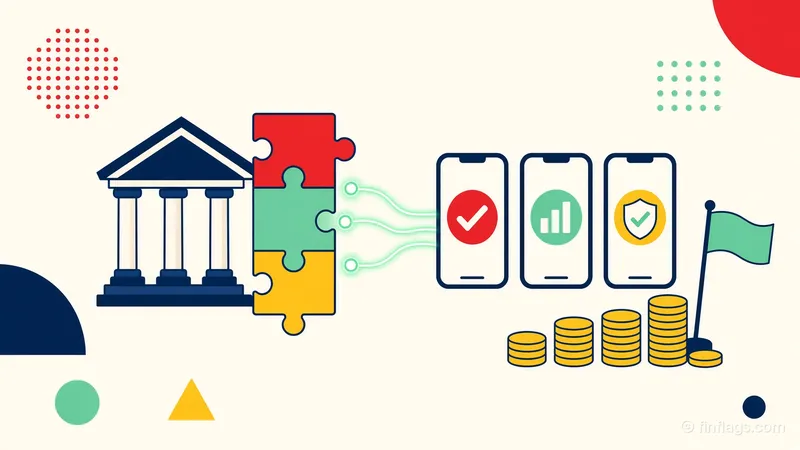
Banking as a service is a setup in which a licensed bank rents out its charter, accounts and cards to a fintech or another nonbank brand through a programming interface, or API. The customer opens the account in the brand’s app and sees the brand’s name. The money sits at the partner bank, which holds the license and, in the United States, the federal deposit insurance.
Finflags read the legal footers and account terms of leading US money apps on November 19, 2026, together with the documents of the three federal bank regulators. In a joint statement of July 25, 2024, the Federal Reserve Board, the Federal Deposit Insurance Corporation (FDIC) and the Office of the Comptroller of the Currency (OCC) wrote that these arrangements “are sometimes referred to as “banking-as-a-service” or “embedded finance” depending on the structure and parties involved in the arrangement.”
The app in the customer’s hand is often not the bank. In the joint statement’s words, a third party “rather than the bank, typically markets, distributes or otherwise provides access to” the account.
| App | Who runs it | Partner bank(s) named in its terms | Own bank charter? |
|---|---|---|---|
| Chime | Chime, a financial technology company | The Bancorp Bank, N.A. or Stride Bank, N.A. | No |
| Cash App | Block, Inc. | Wells Fargo Bank, N.A., Sutton Bank and/or The Bancorp Bank, N.A. | No |
| Venmo | PayPal | The Bancorp Bank, N.A. as issuer of the Venmo Mastercard only; balances at Program Banks that PayPal picks | No |
| Mercury | Mercury, a fintech company (business accounts) | Choice Financial Group and Column N.A. | No |
| Current | Current, a financial technology company | Cross River Bank | No |
| Dave | Dave Operating LLC | Coastal Community Bank or another partner bank | No |
| Robinhood Banking | Robinhood Money, LLC | Coastal Community Bank | No |
| Revolut (US) | Revolut Technologies Inc., program manager | Lead Bank | No |
| SoFi | SoFi Bank, N.A. | None: accounts at its own bank | Yes, national bank |
| Varo | Varo Bank, N.A. | None: cards and accounts at its own bank | Yes, national bank |
| Wise (US) | Wise US Inc., a money services business | Lead Bank and Community Federal Savings Bank for the card; JPMorgan Chase Bank, N.A. as Program Bank for interest balances | No |
Footers of chime.com, venmo.com, mercury.com, current.com, dave.com and robinhood.com; Cash App Terms of Service last updated September 11, 2026; Venmo User Agreement; Revolut Consumer Prepaid Cardholder Agreement effective April 30, 2026; sofi.com, varomoney.com and the footer of wise.com/us. All checked November 19, 2026. N.A. stands for National Association, the mark of a federally chartered bank.
Each row rests on the company’s own legal wording: an app went into the table only when a footer or a published agreement named the bank. SoFi and Varo are in it for contrast.
Who does what in a banking as a service deal
A US banking as a service program usually has three links: the sponsor bank, a technology platform in the middle, and the app. The federal regulators describe the middle link by several names at once: “intermediate platform providers, processors, middleware providers, aggregation layers, and/or program managers.”
| Role | Who it is | What it holds or does | Who supervises it (US) |
|---|---|---|---|
| Sponsor bank | An FDIC-insured bank, national or state-chartered | Holds the deposits, issues the card, stays responsible for compliance | The OCC for national banks; the FDIC or the Federal Reserve, with the state, for state-chartered banks |
| Middleware or program manager | A technology company working under contract with the bank | Can keep the deposit and transaction system of record, process payments, run identity and sanctions checks, service accounts | No bank charter; services it performs for a bank fall under examination by the bank’s federal regulator |
| Fintech app | The brand the customer sees | Markets the account, runs the app, customer service and complaints | No bank charter; the sponsor bank answers to its regulator for the work the app does |
Joint Statement on Banks’ Arrangements with Third Parties to Deliver Bank Deposit Products and Services, July 25, 2024; Interagency Guidance on Third-Party Relationships: Risk Management, final as of June 6, 2023; OCC and FDIC descriptions of their supervisory roles; Bank Service Company Act, 12 U.S.C. 1867(c). Checked November 19, 2026.
Outsourcing does not move the legal duty. The 2023 interagency guidance says that a bank’s use of third parties “does not diminish its responsibility to meet these requirements to the same extent as if its activities were performed by the banking organization in-house.”
The joint statement applies the same rule to compliance work that a partner performs. Suspicious activity monitoring, customer identification and sanctions screening can sit with the fintech or the platform. “Regardless of whether the functions are shared between the bank and the third party, the bank remains responsible for failure to comply with applicable requirements,” the agencies wrote.
The platform in the middle is not out of reach either. Under the Bank Service Company Act, services that a bank has performed for itself by contract are “subject to regulation and examination by such agency to the same extent as if such services were being performed by the depository institution itself on its own premises.” The bank must tell its regulator about such a contract within thirty days.
For a second international option, read our guide to DEGIRO.
Who answers to the customer if the middleman goes bust
Deposit insurance covers the failure of the bank, and nothing else in the chain. The three agencies warned that end users “may not be aware that access to their funds may depend on the third party and that deposit insurance does not protect against losses resulting from the failure of the third party.”
The weak spot is the ledger. When a platform keeps the records of who owns which dollar, a gap in the bank’s access to them “can impair the bank’s ability to determine its deposit obligations,” the joint statement says. Such uncertainty can delay customers’ access to their money.
The 2024 bankruptcy of Synapse Financial Technologies showed that risk in practice, and the Finflags guide to neobank deposit insurance traces what followed. The FDIC proposed a recordkeeping rule for custodial accounts in the Federal Register on October 2, 2024. As of November 19, 2026, the Federal Register lists no final rule under that rulemaking, only the proposal and the extension of its comment period.
The regulators expect sponsor banks to plan for a partner’s collapse ahead of time. Their list of practices includes contingency plans and contract terms that might “address the transfer of the relevant accounts, data, or activities to another entity in the event of the third party’s bankruptcy.”
When pass-through insurance reaches the app’s customer
Federal rules treat the app’s customer as the owner of the deposit when the account is held for that customer. Under 12 CFR 330.7, funds placed in the name of an agent, custodian or nominee “shall be insured to the same extent as if deposited in the name of the principal(s).”
Three conditions decide whether that cover works, the joint statement explains, citing 12 CFR 330.5 and 330.7. The bank’s own account records must show the custodial or agency relationship. The identity and share of each owner must be clear from the bank’s records or from records another party keeps in good faith. The relationship must be genuine, with the money owned by the people named.
The FDIC starts from the bank’s books. Section 330.5 says the agency “shall presume that deposited funds are actually owned in the manner indicated on the deposit account records of the insured depository institution.” This is why clean records at the platform matter as much as the bank’s own health.
How to tell which bank holds the money
The answer sits in the small print at the bottom of the app’s website and in its account agreement. Two phrases do most of the work: a line saying the company is “not a bank” and a line naming who provides the banking services.
Mercury puts both in one place: “Mercury is a fintech company, not an FDIC-insured bank. Banking services provided through Choice Financial Group and Column N.A., Members FDIC.”
Some disclosures leave a name out. The Venmo User Agreement says customer funds go to “one or more banks insured by the Federal Deposit Insurance Corporation (FDIC) that we choose in our discretion” and calls them Program Banks. It adds: “Any other Venmo account funds and all cryptocurrencies are not held in FDIC-insured bank deposits.”
At Revolut in the United States, the Consumer Prepaid Cardholder Agreement sums up a program manager’s role in one line: “Revolut services the Program on behalf of Lead Bank.” A card can also come from a different bank than the balance: Wise names two banks for its US card and a third for its interest balances.
An app with its own charter shows the bank as the provider. SoFi’s footer reads “SoFi Checking and Savings is offered through SoFi Bank, N.A. Member FDIC.” The SoFi review covers who can open that account, and the Chime vs SoFi comparison puts a partner-bank app and a chartered one side by side. The difference between a chartered app bank and an app on a partner bank is the core of what is a neobank.
How banking as a service works in Europe and the UK
European providers often hold the license themselves, so the platform and the regulated institution are one group. Two kinds of license appear: a full banking license, which allows deposits, and an e-money license, which allows accounts, cards and payments but keeps client money safeguarded rather than lent out. The Finflags explainer on what is an EMI sets out how safeguarding differs from deposit insurance.
Solaris sells banking as a service from Berlin on a bank license. The company calls itself “a German technology company with a full banking license,” and its imprint names the Federal Financial Supervisory Authority (BaFin) and the European Central Bank as its supervisors.
ClearBank works the same way in Britain and the Netherlands. Its footer says that “ClearBank Limited is authorised by the Prudential Regulation Authority and regulated by the Financial Conduct Authority and the Prudential Regulation Authority.” Its Dutch arm, ClearBank Europe N.V., is authorized by the European Central Bank and regulated by De Nederlandsche Bank.
Swan, in Paris, uses an e-money license instead. Swan describes itself as “a licensed electronic money institution authorised by the French Autorité de Contrôle Prudentiel et de Résolution (ACPR),” the French banking supervisor, with authorization granted in June 2020.
Modulr runs two e-money institutions. Modulr FS Limited is authorized by the Financial Conduct Authority in Britain, and Modulr Finance B.V. is licensed by De Nederlandsche Bank.
Railsr splits the roles between two companies of one group. “Customers contract with PayrNet for regulated services and with Railsr for technology services,” the company says, and PayrNet Ltd holds a UK e-money license.
The split matters for the customer. Money at a bank provider such as Solaris or ClearBank can be a deposit under a national guarantee scheme. Money at an e-money provider is safeguarded. Revolut serves the European Economic Area through its own bank, Revolut Bank UAB, licensed in Lithuania, while Wise works on the e-money model in Britain.
What regulators now expect from sponsor banks
US supervisors have set out their expectations in steps since 2023. The Interagency Guidance on Third-Party Relationships, final as of June 6, 2023, replaced each agency’s own general guidance and walks banks through the life of a partnership, from planning and due diligence to contract negotiation, ongoing monitoring and termination.
The July 2024 joint statement added detail for deposit programs. It listed risks such as fragmented operations, misaligned incentives, rapid growth and funding concentration, and it warned against misleading claims about deposit insurance. The statement says it “does not alter existing legal or regulatory requirements or establish new supervisory expectations.” On the same day the agencies opened a request for information on bank-fintech arrangements.
Enforcement ran alongside the guidance. On June 14, 2024, six weeks before the joint statement, the Federal Reserve Board issued an enforcement action against Evolve Bank & Trust of West Memphis, Arkansas, a bank that “partners with various financial technology companies.” The Board cited “deficiencies in the bank’s anti-money laundering, risk management, and consumer compliance programs” and required “enhanced procedures related to recordkeeping and consumer compliance programs.”
The pattern for sponsor banks is clear from these papers. A bank can hand the app, the customer service and much of the back office to partners. It keeps the license, the deposits and the legal responsibility.
Where banking as a service goes from here
The custodial records proposal is the next marker for US programs. Until the FDIC finishes it, sponsor banks work from the agencies’ guidance on records and from the terms they write into contracts with their partners. For a customer the practical check stays the same: the bank named in the app’s footer holds the money and answers to the examiners. The Finflags reviews of Chime and Cash App cover two apps built on partner banks.
To compare 456 banks and fintechs in 28 countries on what they ask of foreign residents and visitors on a passport, use our account filter.
You may use the information in this article provided you include a link to Finflags and to this article.
This article covers Chime, Cash App, Venmo, Mercury, Current, Dave, Revolut, Robinhood, SoFi, Varo Bank, Solaris, ClearBank, Swan, Modulr, Railsr and Wise. Written by Mary Jane, our lead journalist, and checked by the Finflags editors. The date above is the date of the event. Fees, limits and terms change: tell us if something here is out of date.