How card payments work
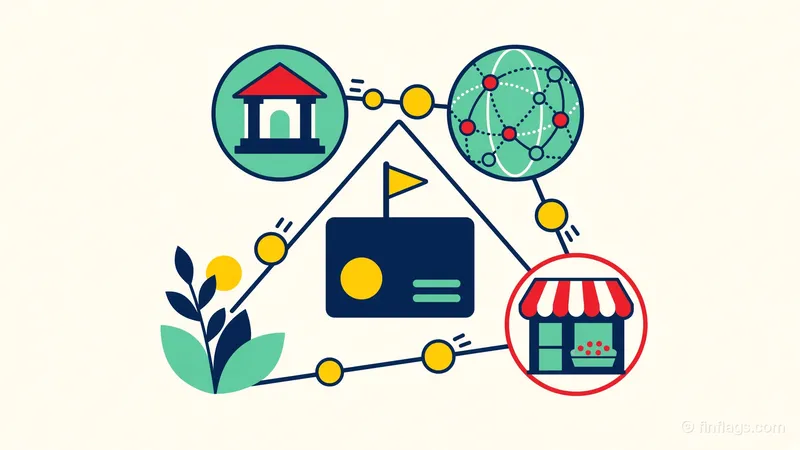
A card ties together an issuer, a network and a merchant’s bank. The way the merchant fee is split explains why high cashback rarely lasts.
In this article
Every card payment passes through several companies. The cardholder sees one of them, the issuer whose name is in the app. The network, the merchant’s bank and the program manager stay out of sight.
What the card number says
The first six to eight digits of a card number form the BIN, the bank identification number. The BIN identifies the issuer and the card product. Public BIN lookup services show which bank actually issued a card. For many fintech cards the answer is a partner bank or electronic money institution, not the fintech itself.
The issuer is the institution that holds the card agreement with the cardholder. Citi, Chase, Revolut and Wise are examples. The network connects issuers with merchants. Visa and Mastercard are the two largest. The card product is the level inside a network, such as Visa Signature or Mastercard World Elite. The product level decides the fees the merchant pays and the benefits the cardholder receives.
Four kinds of card
| Card type | Where the money comes from | Repayment | Account behind the card |
|---|---|---|---|
| Charge card | Issuer pays first | Full balance at the end of each period | Card account, settled by direct debit |
| Credit card | Issuer’s credit line | Full or partial, interest on the rest | Card account with a credit limit |
| Debit card | Cardholder’s own balance | No repayment, funds are held and taken at purchase | Bank or payment account with IBAN and statements |
| Prepaid card | Balance loaded in advance | No repayment | Pooled account held by the issuer, often no IBAN |
American Express built its business on the charge card. The balance is collected in full by direct debit at the end of the statement period. Partial payment is not available on a classic charge card.
Debit cards are the most common type in Europe. The cardholder has a full relationship with the bank or fintech, with identity checks, an IBAN and statements.
Prepaid cards hold money on a balance loaded by the cardholder. The funds sit in an account of the issuer, pooled with the money of other customers. Identity checks are often light. Many crypto cards work this way, as described in crypto card issuers compared.
Before this, we covered Visa in our report “Fuel pump fraud”, from November 12, 2026.
Open networks with four parties
Visa and Mastercard run open networks. A payment moves from the cardholder to the issuer, through the network, to the acquirer and on to the merchant. The acquirer is the merchant’s bank.
The networks do not issue cards and do not hold customer money. They set the rules and route the messages. Any licensed bank can join as an issuer or as an acquirer, and the issuer and the acquirer are usually different companies.
The merchant pays a fee on each payment. The acquirer keeps part of it, the network takes a scheme fee, and the issuer receives the interchange fee. A fintech that issues cards through a partner bank may receive a share of that interchange, or none of it.
A fintech that says its card works in more than 150 countries is describing the reach of Visa or Mastercard. The fintech itself has no contract with those merchants.
Closed networks with three parties
American Express, JCB and Diners Club run closed networks. The network is also the issuer and the acquirer. It deals directly with the cardholder and with the merchant.
A closed network keeps the whole merchant fee. It controls fraud checks and service quality without intermediaries. It must sign each merchant itself, which makes growth slower.
Merchant fees on American Express are higher than on Visa and Mastercard in Europe. Many small shops do not accept the card for that reason. The same fees fund the larger reward programs that American Express offers. The French Platinum card is reviewed in American Express Platinum in France.
Some banks issue American Express cards under license. Those cards often lack the travel and reward benefits of the cards that American Express issues directly.
Interchange in the European Union
The EU Interchange Fee Regulation of 2015 caps interchange on consumer cards. The cap is 0.2% of the payment for debit cards and 0.3% for credit cards. Commercial cards fall outside the cap. Three-party networks are largely exempt unless they license other issuers.
| Network model | Who receives the merchant fee | EU cap on interchange |
|---|---|---|
| Four-party (Visa, Mastercard) | Acquirer, network and issuer | 0.2% debit, 0.3% credit |
| Three-party (American Express, JCB, Diners Club) | The network alone | Largely exempt |
Why cashback rates fall
An issuer of a consumer debit card in the EU receives about 0.2% of each purchase. A card that pays 3% to 5% cashback spends far more than that income. The difference comes from the company’s own funds, from investors or from token issuance.
Several card programs cut or ended such rates after a period of growth. Gnosis Pay ended its consumer cards, as covered in Gnosis Pay ends consumer cards. Ready Wallet lost its card program, covered in Ready Wallet loses its card program.
To compare 456 banks and fintechs in 28 countries on what they ask of foreign residents and visitors on a passport, use our account filter.
This article covers Visa, Mastercard and American Express. Written by Mary Jane, our lead journalist, and checked by the Finflags editors. The date above is the date of the event. Fees, limits and terms change: tell us if something here is out of date.