CRS reporting
Banks report account data to the country of the declared address, and from 2026 e-money accounts join the system above a USD 10,000 average balance
In this article
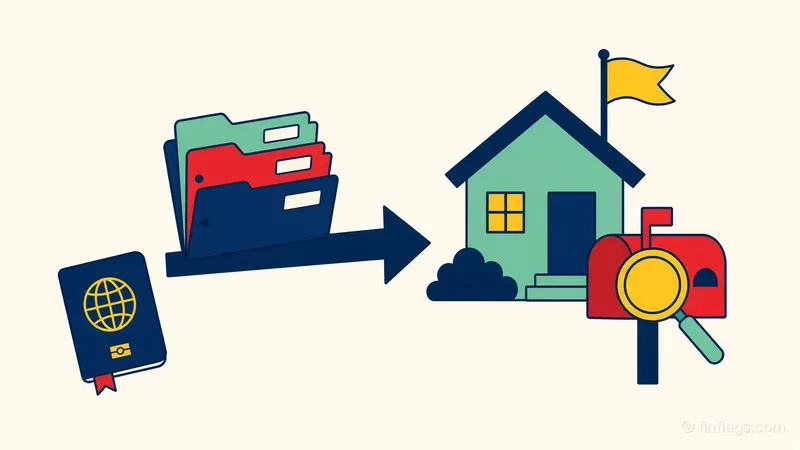
The Common Reporting Standard (CRS) is the OECD system under which banks and other financial institutions report foreign customers’ accounts to tax authorities. A common mistake is to assume that a bank reports by passport. It reports by tax residence, and tax residence is determined mainly by the address the customer gives.
How a bank decides
At account opening, the bank asks for a self-certification form. The customer states a country of tax residence and a tax identification number (TIN).
The bank then checks indicators of residence. These include the residential address, the phone number, the IP address at login and standing instructions to transfer money abroad. Citizenship and the residence permit may play no part.
Four cases
| Customer | Address given to the bank | Where the data goes |
|---|---|---|
| Israeli passport | France | France |
| Ukrainian passport | Ukraine | Ukraine |
| Residence permits in Latvia and Germany | Latvia | Latvia |
| Residence permits in Latvia and Germany | Germany | Germany |
In the first case, the holder of an Israeli passport often assumes the data goes to Israel. The bank follows the French address, so France receives it.
Two residence permits at once are legal and common among people who live in several countries. The permit itself decides nothing. The address in the self-certification and the actual indicators of residence decide.
The fintech’s country is not the customer’s
A fintech licensed in Malta is a Maltese reporting institution. If a customer declares an address in Spain, the chain runs in two steps. The fintech reports to the Maltese tax authority. The Maltese authority passes the data to Spain through the automatic exchange.
The licence country of the fintech is only the first stop. The data ends up in the country of the customer’s address.
E-money joins the system in 2026
The OECD amended the standard, widely called CRS 2.0, and the European Union implemented it through DAC8. The amendments bring electronic money products, central bank digital currencies and, through a separate framework, crypto-assets into scope.
E-money accounts get a low-value exclusion. An account is excluded if its rolling average end-of-day balance over 90 days stays at or below USD 10,000. The UK tax authority’s manual explains that monitoring began on January 1, 2026 and the first rolling calculation falls on March 31, 2026. The average is the sum of the last 90 daily balances divided by 90.
Once the 90-day average goes above the threshold, the account becomes reportable. The first exchange of data for 2026 takes place in 2027.
Which crypto cards and wallets report, and to whom, is covered in DAC8 and which crypto cards report to tax authorities.
On a related subject, read “Best multi currency account”, from November 19, 2026.
What the report contains
The OECD standard sets out the data a reporting institution sends each year for every reportable account.
| Data item | Detail |
|---|---|
| Identity | Name, address, country of tax residence, TIN, date and place of birth |
| Account | Account number and the name of the reporting institution |
| Balance | The balance or value at the end of the calendar year, or at closure |
| Income | Interest, dividends and other income credited during the year |
| Proceeds | Gross proceeds from the sale or redemption of financial assets |
A closed account is still reported for the year in which it was closed. Closing an account in December does not take it out of that year’s exchange.
The United States does not take part in CRS. It runs its own system, FATCA, under which foreign banks report accounts of US persons to the US tax authority. A US citizen living in Europe can therefore appear in FATCA reporting to the United States and, through the declared address, in CRS reporting to the country of residence.
Moving does not update the bank
A change of residence on paper does not reach the bank by itself. Until the customer files a new self-certification with the new address and TIN, the bank keeps reporting on the old data. Some long-established European banks are slow to update these records internally.
| Rule | Detail |
|---|---|
| Residence for CRS | The address given to the bank, not the passport or residence permit |
| Two residence permits | Data goes to the country of the address actually declared |
| Fintech’s licence country | First stop only; data is passed on to the customer’s country |
| E-money exclusion from 2026 | 90-day average balance at or below USD 10,000 |
Which banks and fintechs open an account on your passport is in our account filter, which covers 456 providers in 28 countries.
Written by Mary Jane, our lead journalist, and checked by the Finflags editors. The date above is the date of the event. Fees, limits and terms change: tell us if something here is out of date.